1940–1945
Between 1940 and 1945
The Netherlands Reformed manse opposite the Roman Catholic church on the Dorpsstraat serves as a Schreibstube, an orderly room, for the German troops billeted in Nieuwveen.
1940 – 1945
Roovers writes that Nieuwveen was spared any fighting. In military terms that is correct. The village nonetheless lost inhabitants to the occupation.
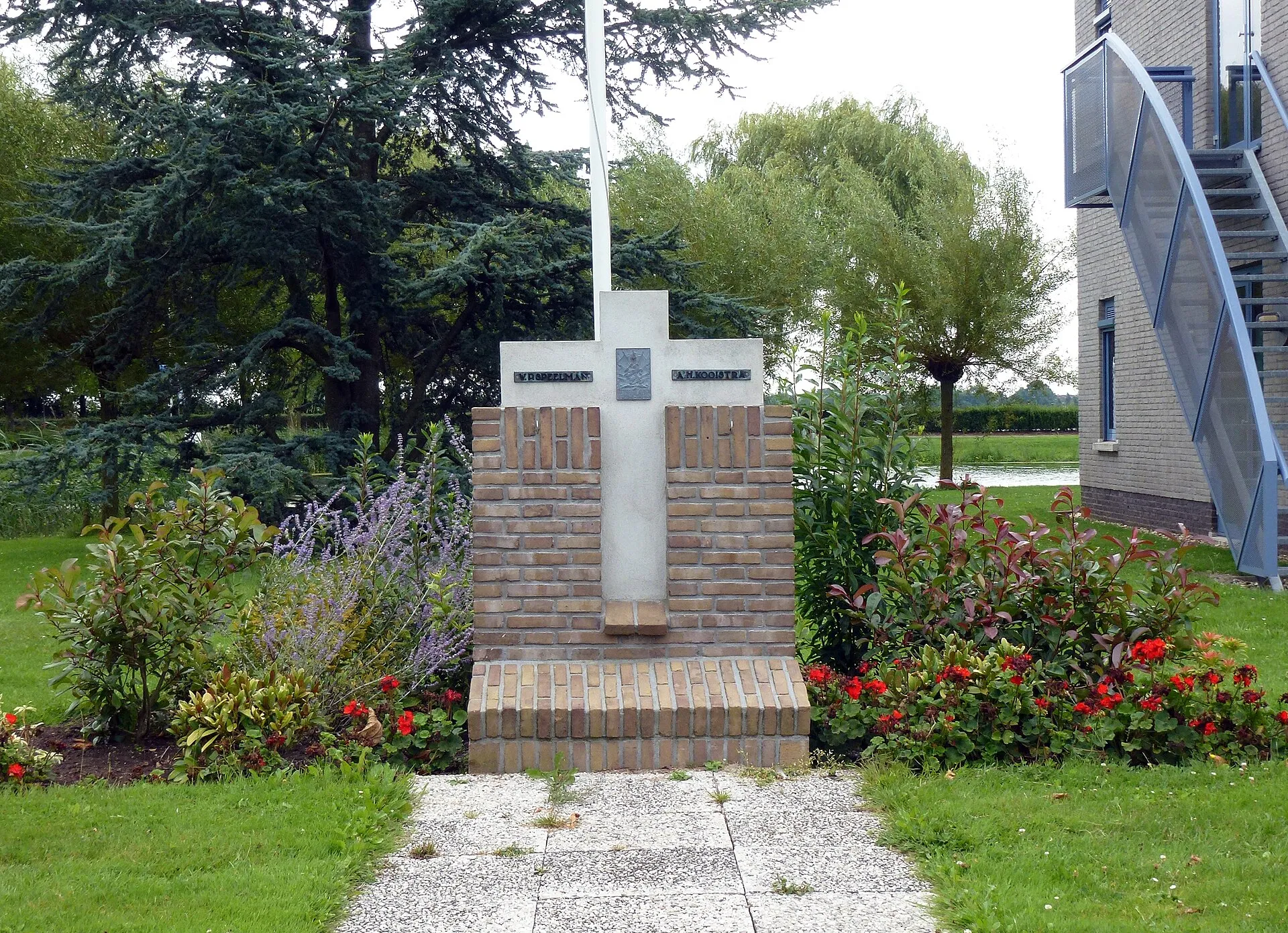
Three Jewish residents of the Johannesstichting were deported in 1943 and murdered at Sobibor. Willem Pieter Speelman was executed by firing squad at Halfweg on 17 February 1945, twenty-six years old.
1940–1945
The Netherlands Reformed manse opposite the Roman Catholic church on the Dorpsstraat serves as a Schreibstube, an orderly room, for the German troops billeted in Nieuwveen.
1940–1945
Unlike in the First World War of 1914–1918, Nieuwveen too has a hard time of it. In the winter of 1944–1945 food was very scarce: money got you little, bartering got you further.
Roovers closes with the remark that Nieuwveen was spared any fighting. In military terms that is correct, but the village did indeed lose inhabitants to the occupation.
1940–1945
Henk Kooistra is killed as well. Kooistra and Speelman were friends from Nieuwveen who both studied in Amsterdam, became involved in the resistance there early on, and were active in the clandestine distribution of pamphlets and of the newspapers "Vrij Nederland" and "Trouw".
Streets in the village were named after both of them after the war; Nieuwveen has a war memorial bearing their names.
1942
The municipality adopts its very first expansion plan.
1943
Three Jewish residents of the Johannesstichting are arrested, deported to Camp Vught and murdered shortly afterwards at the Sobibor extermination camp. Two of them were Mozes Ricardo (born 29 December 1881) and Rebekka Worms (born 21 September 1891).
1945
Willem Pieter Speelman is executed by firing squad at Halfweg, together with nine others, in reprisal for a resistance attack on the Amsterdam–Haarlem railway line. He was 26.
Speelman (Sellingen, 20 January 1919) was a son of the gereformeerde minister of Nieuwveen and read economics at the Vrije Universiteit. Shortly after the German invasion he began writing pamphlets calling for resistance. He was arrested at the end of 1942 but escaped using a hacksaw blade hidden in the sole of his shoe. Early in 1943 he was a co-founder of the underground newspaper Trouw, and became the linchpin of its distribution network. On 29 January 1945 he was arrested again in a raid on the S.J.P. Bakker printing works in Amsterdam; under interrogation he gave nothing away.
He was reburied at the Eerebegraafplaats Bloemendaal, the Field of Honour, and posthumously received the Resistance Cross 1940–1945. His parents were imprisoned several times during the occupation to make them reveal their son's whereabouts, and lived for a time in Noordwijk to escape the occupier's attention.