Around the eleventh century
The first inhabitants settle in the area around Nieuwveen. They begin draining the peat soil and bringing it into cultivation, so that it slowly becomes fit for arable farming and cattle.
1050 – 2026
One hundred and thirty-seven events across 976 years. They are not evenly spread: almost everything falls between 1830 and 1970, and almost nothing before it.
The true scale: one tick per event, at its real year.
Searches headings and text.
showing 137 of 137
Within an era the scale is true; between eras, time has been compressed.
The first inhabitants settle in the area around Nieuwveen. They begin draining the peat soil and bringing it into cultivation, so that it slowly becomes fit for arable farming and cattle.
A settlement takes shape here that will later be called Nieuwveen.
The name shifted considerably over the centuries: first Nuenvene, then Nijeveen and Niuweveen, in the seventeenth century Nieuveen, after that Nieuweveen, and from 1795 Nieuwveen.
The ground holds a layer of fen peat, laagveen. Digging it away gets under way.
By this date a small Roman Catholic church already stands on the Kerkstraat (Church Street).
The oldest firm mention of the village name. Count Willem III grants permission to sell "die leenacker legghende bi der kerc lane te Nuwenvene" — the fief-field lying by the church lane at Nuwenvene. Both the name Nuwenvene and the Kerkstraat – then "der kerc lane" – are therefore on record in 1331.
The medieval church was dedicated to Saint Nicholas and was in the gift of the Counts of Holland.
Count Willem states that he has no objection to the exchange of Willem van Schade, priest at Nieuwveen, with one Servaas, priest at Bunschoten.
A new Roman Catholic church goes up on the Kerkstraat, replacing the small one already there. The old church was dedicated to St Anne; the new one took St Nicholas as its patron.
The Reformation reaches Nieuwveen. The 1559 church on the Kerkstraat passes into Reformed hands. The village's Catholics from now on belong to the parish of Zevenhoven.
The oldest house still standing in Nieuwveen dates from this year, according to the Kadaster, the Dutch land registry.
By this date a general village school is already standing beside the Reformed church on the Kerkstraat.
The water of the peat lakes swallows the neighbouring village of Schoot and the Uiterbuurt. Nieuwveen escapes by a hair.
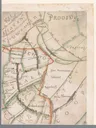
Rijnland in 1615, with Nieuwveen and Nieuwkoop. The map is nearly a century older than the entry beside it, and shows the area before the water had taken so much of the land. View larger → Nieuwveen is no longer governed directly. The Counts of Holland did so first, then — until 1724 — the States of Holland.
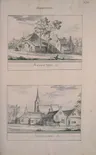
Nieuwveen in the Atlas Schoemaker, eighteenth century — the village as a draughtsman saw it, in the century it was sold as a manor. View larger → For f 15,500,– the heerlijkheid of Nieuwveen — a manorial lordship, carrying rights of jurisdiction and appointment — passes from the States of Holland to the City of Haarlem.
Gerrit Willem van der Laan, lord of the manor, transfers the neighbouring ambachtsheerlijkheid of De Uiterbuurt to the City of Haarlem. From this comes the name Nieuwveen met den Uiterbuurt.
The polders under Kalslagen, Nieuwveen and de Uiterbuurt. De Uiterbuurt, sold as a manor in the entry beside this, is named on the map. View larger → The peat lakes keep growing and there is less and less to be earned in the village. Nieuwveen falls into crisis and many peat workers are left without work. By the end of the eighteenth century barely more than 500 people live there.
“A new drawing towards the drainage of the peat-dug lands”, 1742. The plan to push the water back is nearly sixty years older than the drainage itself. View larger → The corn mill De Fortuijn is put up on what is now the Uiterbuurtweg.
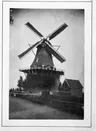
A corn mill in Nieuwveen, from a photograph album. Whether this is “De Fortuijn”, raised in the entry beside it, the source does not say. View larger → Draining of the peat lakes around Nieuwveen begins. Seven windmills set to work pumping the water out into the Amstel.
“A new drawing towards the drainage of the peat-dug lands”, 1742. The plan to push the water back is nearly sixty years older than the drainage itself. View larger → The Nieuwkoop and Zevenhoven droogmakerij – the drained lake-bed polder – becomes a fact. The drainage was a state undertaking.
The drainage is completed.
The Zevenhoven polder is drained by eight vijzelmolens, Archimedes-screw mills, set up in four "gangs" of two mills each, lifting the water in two stages. The original document speaks of seven mills; the difference probably lies in what exactly was counted as Nieuwveen.
The polder lies deep – the water level is 5.90 metres below NAP, the Dutch ordnance datum – and suffers badly from seepage, which makes daily pumping necessary and keeps it so.
The land won by the draining is parcelled out. For the village it is a fresh start.
The first farms go up in the drained polders. With the work the village grows too: more inhabitants, more houses.
The river Aar is substantially improved and the Aarkanaal dug. The old bridge, the Duivelsbrug (Devil's Bridge), gives way to a wooden double-leaf drawbridge that comes to be called the Kattenbrug.
The Kattenbrug over the Aarkanaal. The canal is dug in the entry beside this; the bridge still crosses it. View larger → The Duivelssluis, the lock in the Aar beside the Duivelsbrug, falls out of use. A new complex of locks at the Tolhuis in Leimuiden takes its place.
A cattle market is instituted, to be held in the Kerkstraat.
A new general village school opens beside the Reformed church on the Kerkstraat.
The schoolmaster’s house. Whether it housed the master of the school in the entry beside this, the source does not say — the house still stands. View larger → The church on the Kerkstraat, built by the Catholics in 1559 and Reformed since 1578, is pulled down.
A likely cause of the building's poor condition is the draining of the polder twenty years earlier: the church stood on the edge of the drained polder, and its foundations subsided.
The foundation stone is laid for the new Reformed church on the same site. The architect is Elsmeyer of Nieuwkoop.
Under the State Regulation of 1798 the tower had become the property of the civil municipality, and it is therefore rebuilt at the municipality's commission, to a design by Theo Molkenboer of Leiden. The cost is estimated at 2,100 guilders.
The new Reformed church in the Kerkstraat is taken into use.
The church taken into use in 1832 in the entry beside this, a little over a hundred and forty years later. View larger → Nieuwveen gets its first industry: the wind-powered sawmill De Angenieta, near the Kattenbrug, founded by Jeremias Schoenmakers — son of the Reformed minister Pieter Schoenmakers. The Zaagmolenpad (Sawmill Path) is named after this mill.
Nieuwveen too has a cholera epidemic to endure. Eighty people die of it, a tenth of the population.
The Reformed minister Pieter Schoenmakers has a large gentleman's house put up on the Dorpsstraat. Out of it grew Sassenoord, and in 1935 Huize Sint Ursula.
A two-manual organ with ten stops is built for the Reformed church by H. Knipscheer. The instrument has survived virtually unaltered; the independent pedal division is a later addition of 1968.
The interior, looking towards the organ. The instrument in the entry beside this was built in 1858 by H. Knipscheer. View larger → The Leiden firm De Volharding starts a steamboat service to Amsterdam and to Leiden, carrying passengers as well as goods. The landing stage was by the Kattenbrug.
A number of Nieuwveen Catholics petition the bishop of Haarlem to be allowed to continue as a parish of their own. Until then they went to church in Zevenhoven.
The parish of St Nicholas is founded, two years before the church building is taken into use.
Nieuwveen on Kuyper's municipal map, around 1866 — the village as it lay when the parish was founded. View larger → The village gets its first public street lighting: paraffin lanterns. A stubborn fight in the gemeenteraad, the municipal council, came first, and among the population too those for and against were sharply opposed.
The first Roman Catholic church since the Reformation opens on the Dorpsstraat. It had no tower yet; that would follow as soon as the money was there.
The Roman Catholic church on the Dorpsstraat, the first since the Reformation. View larger →
Opposite the present Raadhuis (town hall) on the A.H. Kooistrastraat, the foundation stone goes down for the small church of the Evangelisation Society.
The wind-driven drainage mills disappear one by one; steam pumping stations elsewhere take over their work.
Not all the mills go this early: the lower mill H of the Zevenhoven polder on the Ringdijk, built in 1810, stands until 1926.
A mill near Nieuwveen, from an album of 1851–1891 — the years in which the water mills were being cleared away. View larger →
The first Roman Catholic primary school opens on the Dorpsstraat, opposite the Roman Catholic church.
A great fire strikes the village. On what is now the A.H. Kooistrastraat and in the Kerkstraat, two substantial farms, a café and some ten houses are lost, and with them a large part of the municipal archive.
The first Protestant primary school opens on the corner of the Kerkstraat.
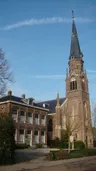
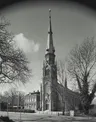
The Roman Catholic church on the Dorpsstraat, in use since 1867, gets its tower after all. The parish priest, J.J. Bruijstens, paid for it out of his own pocket.
The tower was designed by Everardus Margry of Rotterdam, who also designed the church at Hoogmade and the St Bonifatius church in Alphen aan den Rijn. Its height including the cross is 48 metres; the spire alone is 22 metres.
In the porch stand two monumental memorial stones: one of 1559, from the first Nicolaaskerk in the Kerkstraat, and one of 1740, from the old presbytery at Zevenhoven.
The tower and its entrance. The priest paid for it out of his own pocket, according to the entry beside this. View larger → Founding of the Vereniging Johannes Stichting by Dr J. Sasse.
The story begins earlier: the evangelist Smit took in children from the big cities at the Polderhuis, which stood at the crossroads in the village. Out of this came both the Marthastichting and the Johannes Stichting.
The aim was to run an institution for old and infirm people who could not keep themselves and were not cared for by their families – in its own words: "cast-out, uncared-for, dependent, old, weak or infirm persons, whether married or unmarried". Men and women lived separately at first.
The foundation stone for the Johannes Stichting is laid on the street then still known in common speech as the Dorpsstraat, now the A.H. Kooistrastraat.
Dr Sasse proposes carrying the organ of his Johannesstichting over to the school every Sunday, to accompany the singing of the gereformeerde congregation.
The Nieuwkoop steam pumping station is built at Korteraar to a design by W.C. and K. de Wit, fitted with two British Gwynnes centrifugal pumps. It takes over the drainage of the droogmakerij.
The Gereformeerde Kerk on the Kerkstraat opens.
The sawmill De Angenieta by the Kattenbrug, dating from 1846, is pulled down, timber sheds and all. Pieter Schoenmakers carries the business of the firm J. Schoenmakers on at the Amsterdam Houthaven, where it comes to great prosperity.
The Zaagmolenpad — “sawmill path”. The sawmill pulled down in the entry beside this is gone; its name is still in the street. View larger → For the first time a bicycle with pneumatic tyres is sold to someone in Nieuwveen. The buyer was the municipal clerk W. van der Vos; the supplier, the firm Stichter.
Less and less butter and cheese is made on the farms themselves. Mixed holdings appear, with arable farming alongside cattle.
A Boerenleenbank, a farmers' credit bank, is founded — now better known as a Raiffeisenbank.
The buildings of the Ons Belang cooperative — grinding, cattle feed and the like — go up on the Oude Nieuwveenseweg. They stand on the site where the sawmill of the firm J. Schoenmakers had been from 1846 to 1896.
The farmers of Nieuwveen begin using artificial fertiliser.
The Ons Belang cooperative, on the Oude Nieuwveenseweg since 1905, builds an extension.
The station building at Nieuwveen is built, to the Hesm I standard type.
The station building in 2017. The line closed in 1936; the building stayed. View larger → Elim, the Johannes Stichting's annexe on the Kerkstraat where the women lived, burns down. There were no casualties.
After this fire men and women lived in a single building.
Market gardening begins along the Jaagpad by the Amstel: growing vegetables, at first in unheated ground.
Motorcycles, cars and lorries make their appearance in Nieuwveen too.
Opening of the railway connection between Uithoorn and Alphen aan den Rijn, with among others a station "Nieuwveen", at the end of what is now the W.P. Speelmanweg.
The original document gives 1916 as the year of opening and Amsterdam as the terminus; the line ran from Uithoorn to Alphen aan den Rijn and opened on 1 August 1915.
The line was 23 kilometres long and was built by the Hollandsche Electrische-Spoorweg-Maatschappij as part of the Haarlemmermeer railways. Because it mostly carried horticultural produce, it was popularly nicknamed "het bonenlijntje", the bean line.
The gemeenteraad abolishes the funfair, held from of old in the Kerkstraat.
The HESM opens a short goods branch from Nieuwveen to Papenveer. The station there is given the name of Ter Aar, two kilometres further on.
The Nieuwveen–Ter Aar branch on a map of 1914, attached to the interest-free advance from the treasury that paid for the line. View larger → The steamboat services to Amsterdam and Leiden are discontinued. The Leiden firm De Volharding had run them since 1860.
The pumping station at Korteraar is converted from steam.
Electricity reaches Nieuwveen for the first time. Candles and paraffin lamps disappear; electric motors make their entrance.
The paraffin lanterns of 1867 give way to electric street lighting.
The gemeenteraad abolishes the cattle market in the Kerkstraat, held since 1828. Interest had already dwindled sharply around 1900.
A single fire pump with a petrol engine replaces the two hand pumps. It shifts 900 litres of water a minute.
A daily bus service to Alphen aan den Rijn and Leiden begins, set up by P. Langhout of Ter Aar.
G. Koppenol of Nieuwveen starts the first daily bus service to Amsterdam. On Fridays a service runs to Leiden, for those visiting the cattle market there.
The present Kattenbrug is built.
It replaced the wooden double-leaf drawbridge of 1823–1825. At this point Roovers gives 1824 as the year that wooden bridge was built, and 1823–1825 elsewhere.
The bridge that replaced the wooden drawbridge in 1925, in the entry beside this. View larger → The lower mill H of the Zevenhoven polder on the Ringdijk, built in 1810, disappears. What remains of it still stands and is in use as a house.
The office of mayor, shared from of old with Zevenhoven, is split. Nieuwveen gets J.W. Geesink; Zevenhoven, W.J. Boxce.
The Kerkstraat, until then surfaced with fine gravel, is the first road in the village to get a coat of road tar.
The first typewriter appears at the municipal office, an Underwood.
The former municipal secretariat, which was also the post office. This is where the village’s first typewriter stood, according to the entry beside this. View larger → The Johannes Stichting expands with a second house, Sterrenberg at Huis ter Heide.
The Ursuline sisters of Bergen are sent out to The Hague and Leiden to found boarding institutions there: Huize Angela and the Lidwinahuis.
Drinking water now comes from the mains, supplied by De Elf Gemeenten at Woerden. Rainwater and ditch water fall out of use.
Founding of the football club s.v. Nicolaas Boys, with a ground on what is now the W.P. Speelmanweg.
The country house Sassenoord on the Dorpsstraat, once founded by the Revd Pieter Schoenmakers, has been bought by the St. Joseph Stichting of Bergen (North Holland) and becomes a Roman Catholic residential institution for children with intellectual disabilities — geestelijk gestoorde kinderen, in the words of the day. The house is renamed Huize Sint Ursula.
The corn mill De Fortuijn on the Uiterbuurtweg, built in 1800, is demolished. With it the last mill in Nieuwveen disappears.
The office of mayor of Nieuwveen is merged with that of Rijnsaterwoude and Leimuiden. Mayor J.A. Bakhuizen, successor to J.W. Geesink, lives at Leimuiden and stays there. The arrangement did not go down well in Nieuwveen.
Closure of the railway connection Uithoorn – Alphen aan den Rijn, and with it the closure of Nieuwveen station.
The line had never paid its way from the outset. The station building of 1913 still stands and is now in use as office space, at W.P. Speelmanweg 39a.
The Raadhuis (town hall) on the A.H. Kooistrastraat is officially opened.
The Netherlands Reformed manse opposite the Roman Catholic church on the Dorpsstraat serves as a Schreibstube, an orderly room, for the German troops billeted in Nieuwveen.
Unlike in the First World War of 1914–1918, Nieuwveen too has a hard time of it. In the winter of 1944–1945 food was very scarce: money got you little, bartering got you further.
Roovers closes with the remark that Nieuwveen was spared any fighting. In military terms that is correct, but the village did indeed lose inhabitants to the occupation.
Henk Kooistra is killed as well. Kooistra and Speelman were friends from Nieuwveen who both studied in Amsterdam, became involved in the resistance there early on, and were active in the clandestine distribution of pamphlets and of the newspapers "Vrij Nederland" and "Trouw".
Streets in the village were named after both of them after the war; Nieuwveen has a war memorial bearing their names.
The memorial on the Teylersplein. The cross carries the names A.H. Kooistra and W.P. Speelman, and the words “Van tyrannie bevrijd” — freed from tyranny — with the dates 10 May 1940 to 5 May 1945. View larger → The municipality adopts its very first expansion plan.
Three Jewish residents of the Johannesstichting are arrested, deported to Camp Vught and murdered shortly afterwards at the Sobibor extermination camp. Two of them were Mozes Ricardo (born 29 December 1881) and Rebekka Worms (born 21 September 1891).
Willem Pieter Speelman is executed by firing squad at Halfweg, together with nine others, in reprisal for a resistance attack on the Amsterdam–Haarlem railway line. He was 26.
Speelman (Sellingen, 20 January 1919) was a son of the gereformeerde minister of Nieuwveen and read economics at the Vrije Universiteit. Shortly after the German invasion he began writing pamphlets calling for resistance. He was arrested at the end of 1942 but escaped using a hacksaw blade hidden in the sole of his shoe. Early in 1943 he was a co-founder of the underground newspaper Trouw, and became the linchpin of its distribution network. On 29 January 1945 he was arrested again in a raid on the S.J.P. Bakker printing works in Amsterdam; under interrogation he gave nothing away.
He was reburied at the Eerebegraafplaats Bloemendaal, the Field of Honour, and posthumously received the Resistance Cross 1940–1945. His parents were imprisoned several times during the occupation to make them reveal their son's whereabouts, and lived for a time in Noordwijk to escape the occupier's attention.
The memorial on the Teylersplein. The cross carries the names A.H. Kooistra and W.P. Speelman, and the words “Van tyrannie bevrijd” — freed from tyranny — with the dates 10 May 1940 to 5 May 1945. View larger → The market gardens along the Jaagpad by the Amstel switch from vegetables to flowers.
The Jaagpad along the Amstel, where market gardening gave way to growing flowers. View larger → Mechanisation on the farms of Nieuwveen carries on. Farm work appeals to workers less and less; many take jobs elsewhere, in the rising industries and in house building.
Heated glasshouses for flower growing keep going up along the Jaagpad. Vegetable growing declines further.
The municipality builds the first Housing Act houses on the W.P. Speelmanweg — four of them, with a state subsidy.
Beside his house on the Oude Nieuwveenseweg, the vet Adr. Boogaerdt sets up a small animal hospital with an operating room, for livestock as well as pets.
The gemeenteraad adopts a bye-law giving every street and road in Nieuwveen an official name — for the first time ever.
On that occasion the names of the two men of the resistance who were killed are fixed: the Stationsweg becomes the W.P. Speelmanweg and part of the Oude Nieuwveenseweg becomes the A.H. Kooistrastraat. That explains the street names Roovers uses throughout without explanation.
The Rijkstelefoon, the state telephone service, is automated in Nieuwveen under the dialling code 01723.
The first sub-post office had already opened in 1851, at the house of mayor S. van Driel on what is now the A.H. Kooistrastraat, beside the Raadhuis, in a room that served as the municipal office. He was the first kantoorhouder, office-keeper, though the title at the time was still brievengaarder, letter-gatherer.
Huize St. Ursula gets a church of its own on the grounds.
Queen Juliana, on a working visit to the Rijnstreek, calls at Huize St. Ursula on the Dorpsstraat. She stayed about three quarters of an hour.
The clothing workshop Kwiek opens in the Schoterveld expansion plan, with work for about 60 women. Only a few girls from Nieuwveen itself come to work there.
The first houses of Schoterveld go up in the Nieuwkoop polder, west of the W.P. Speelmanweg. Never before had anything been built in the municipality's agricultural area.
A new school with twelve classrooms and a gymnasium opens on the grounds of Huize St. Ursula, for special primary education.
More and more commuters settle in the Schoterveld expansion plan. They buy houses of their own, built with a state grant or in the private sector without government support. The make-up of Nieuwveen's population changes profoundly as a result.
The clothing workshop Kwiek, started in Schoterveld in 1955, closes. The municipality buys the building and fits it out as a gymnasium, chiefly for primary school pupils. In the evenings local clubs use it, among them the gymnastics club Kwiek.
The Boerenleenbank (Raiffeisenbank) moves into a new building on the Oude Nieuwveenseweg, the manager's residence on the upper floor.
The new Roman Catholic infant school Nieuwe Oogst opens on the Dorpsstraat, opposite the Roman Catholic church. For a hundred years the manse of the Netherlands Reformed congregation stood on that site.
Founding of the Jostiband Orkest, as the music club of the JOhannes STIchting – hence the name – by Wim Brussen and Frits van der Scheer. The first performance takes place on 5 December 1966. Residents of Huize Ursula join early on as well.
The orchestra later grew into the largest orchestra in the world made up entirely of musicians with an intellectual disability.
The Johannes Stichting decides definitively to devote itself solely to the care of people with an intellectual disability.
Plans for a new Protestant infant school in the Conradpark are well advanced.
Nieuwveen reaches 3000 inhabitants. That includes the residents of the Johannes Stichting and Huize St. Ursula: together some 800 people, patients and nursing staff. Both institutions had grown strongly in those years and become known nationally.
The small church of the Evangelisation Society, dating from 1870, is demolished. In its place comes the Netherlands Reformed meeting hall 't Anker.
The buildings of the Ons Belang cooperative on the Oude Nieuwveenseweg, dating from 1905 and extended in 1912, close. An electrical installation firm buys them.
A new provincial road is being laid out, largely on the old railway bed between the former Nieuwveen station on the W.P. Speelmanweg and De Driesprong at Blokland. It is expected in the spring of 1972 and is meant to take through traffic out of the heart of the village, where it causes congestion every day.
A new state primary school is to be built in the Conradpark.
The gemeenteraad of Nieuwveen, seven members strong from of old, goes to eleven now that the village numbers 3000 inhabitants.
Nieuwveen is connected to the national mains gas network. The coal stoves used from of old, and the oil stoves burning domestic heating oil that had come into use alongside them, are cleared out in great numbers; bottled gas (Butagas) for heating goes out of date.
On the Jaagpad along the Amstel, mains gas is not yet available.
Roovers' series stops here. Everything after this comes from other sources.
This is where Roovers’ series stops.
The series ends in 1970. Everything after it was researched later.
The new provincial road is completed; the last section is taken into use in 1972, exactly as the original document predicted. The road follows the course of the closed branch railway and relieves through traffic in the built-up area.
The road is later called the N231; part of it bears the name "Oude Spoorbaan", old railway bed, to this day.
The Johannes Stichting leaves Nieuwveen. For want of room the residents move to a new complex, De Hooge Burch at Zwammerdam.
With that, after 86 years, the institution that had stood in the middle of the village since the foundation stone was laid in 1888 disappears. The buildings on the A.H. Kooistrastraat are demolished later.
The Jostiband Orkest moves with them; Zwammerdam has been its home base ever since.
Nieuwveen numbers 3,224 inhabitants over an area of 863 hectares.
That is 224 more than the 3,000 of 1969, but the village itself grew by more than that difference suggests: the 1969 figure still counted the roughly 800 patients and nursing staff of the two institutions, and the Johannes Stichting left Nieuwveen in 1974.
In a local government reorganisation the north-eastern part of the Zevenhoven polder, called "Blokland", is added to the municipality of Nieuwveen. This area previously belonged to the municipality of Mijdrecht in the province of Utrecht.
The population rises as a result to 3,597. The municipality now consists of the settlements of Nieuwveen, Blokland and part of Vrouwenakker.
The municipality of Zevenhoven is merged with the municipality of Nieuwveen. The new municipality bears the name Nieuwveen for the time being.
That is the end of the independent existence of the neighbouring municipality with which Nieuwveen even shared a mayor until 1927.
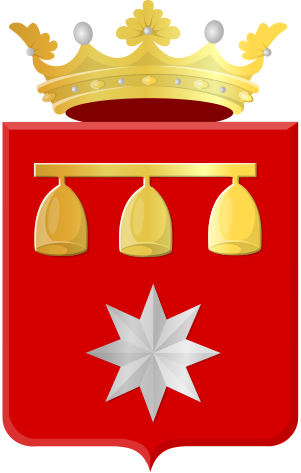
The municipality is renamed LIEMEER. After centuries the name Nieuwveen disappears from the map as the name of a municipality; the village of course remains.
The municipality of Liemeer comprises Nieuwveen, Zevenhoven, Noorden and Vrouwenakker.
The municipal flag of 1968. In 1994 the name Nieuwveen disappeared as a municipality, and the flag went with it. View larger → The Protestant primary school in Nieuwveen closes its doors for want of pupils.
The municipality of Liemeer merges with Ter Aar and Nieuwkoop to form the new municipality of NIEUWKOOP. Liemeer still numbered 6,962 inhabitants in November 2006.
The town hall of the new, far larger municipality comes to stand on the Teylersplein in Nieuwveen. The village thereby houses the government of a municipality of nearly 30,000 people – a remarkable sequel to the Raadhuis taken into use on the A.H. Kooistrastraat in 1937.
The Hervormde Gemeente and the Gereformeerde Kerk of Nieuwveen merge into a single Protestant congregation.
Services are henceforth held in the former Reformed church on the Kerkstraat, completed in 1832, which on the merger is given the name "DE ONTMOETINGSKERK", the Meeting Church. The Gereformeerde church building taken into use in 1895 thereby loses its function.
The church in 2022, by then the Ontmoetingskerk — the name that came with the merger in the entry beside this. View larger →
Founding of the Parochiefederatie HH. Clara en Franciscus, into which the parish of St Nicholas, founded in 1865, is absorbed. It later continues as the Heilige Clara Parochie.
The zoning plan for the SCHOTERHOEK II industrial estate is adopted: an extension of about 10 hectares on the south side of the village. The first plots are planned to be issued at the end of 2015.
The Jostiband celebrates its fiftieth anniversary with a concert in a sold-out Ziggo Dome in Amsterdam, in the presence of King Willem-Alexander.
Work begins on laying a heat network at Schoterhoek II. The heat source is the effluent – treated wastewater – of the Nieuwveen wastewater treatment plant, combined with aquifer thermal energy storage.
The industrial estate is developed entirely without gas. The businesses become joint owners of the network through a cooperative. On 17 September 2021 the name and logo of the heat network are unveiled.
Exactly fifty years after being connected to the mains gas network in 1970, Nieuwveen thereby takes its first step away from it again.
Ipse de Bruggen draws up an investment plan for the period 2020–2032 for making the property on Landgoed Ursula more sustainable and renewing it.
On the 40-hectare estate – grown out of the gentleman's house the Revd Pieter Schoenmakers built on the Dorpsstraat in 1848, by way of "Sassenoord" and "Huize Sint Ursula" of 1935 – some 450 to 500 people with an intellectual disability live. Among other things eighty new care studios are being built, spread over two buildings.
Three Stolpersteine are unveiled on the Weteringplein for the Jewish residents of the former Johannesstichting who were deported and murdered in 1943.
The town of Nieuwveen numbers 4,559 inhabitants, against 3,742 in 2013 – a growth of 22 per cent in thirteen years. There are 1,641 dwellings, about three quarters of them owner-occupied.
The historic core of the village is a protected conservation area.
The diocese of Rotterdam agrees to the disposal of three of the six church buildings of the Heilige Clara Parochie. The H. Nicolaaskerk on the Dorpsstraat – taken into use on 19 August 1867, with the 1886 tower paid for out of his own pocket by parish priest J.J. Bruijstens – closes in 2028.
The parish council is aiming to keep the listed buildings in use with a new public function.
The Jostiband is sixty years old and is appointed Ambassador of Freedom by the Nationaal Comité 4 en 5 mei, the national committee for the days of remembrance and liberation.