Skip to content
Nieuwveen
Era

The drainage and the rebuilding

1800 – 1898

34 events

1809

In 1809

The Nieuwkoop and Zevenhoven droogmakerij – the drained lake-bed polder – becomes a fact. The drainage was a state undertaking.

drainage polder Researched later
1810

In 1810

The drainage is completed.
The Zevenhoven polder is drained by eight vijzelmolens, Archimedes-screw mills, set up in four "gangs" of two mills each, lifting the water in two stages. The original document speaks of seven mills; the difference probably lies in what exactly was counted as Nieuwveen.
The polder lies deep – the water level is 5.90 metres below NAP, the Dutch ordnance datum – and suffers badly from seepage, which makes daily pumping necessary and keeps it so.

drainage mills polder Researched later
1810–1812

Between 1810 and 1812

The land won by the draining is parcelled out. For the village it is a fresh start.

drainage farming From the typed document
1812–1850

Between 1812 and 1850

The first farms go up in the drained polders. With the work the village grows too: more inhabitants, more houses.

farming population From the typed document
1823–1825

From 1823 to 1825

The Duivelssluis, the lock in the Aar beside the Duivelsbrug, falls out of use. A new complex of locks at the Tolhuis in Leimuiden takes its place.

water bridges infrastructure From the typed document
1828

In the year 1828

A cattle market is instituted, to be held in the Kerkstraat.

cattle market economy From the typed document
1831

In 1831

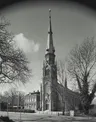
The church on the Kerkstraat, built by the Catholics in 1559 and Reformed since 1578, is pulled down.
A likely cause of the building's poor condition is the draining of the polder twenty years earlier: the church stood on the edge of the drained polder, and its foundations subsided.

church demolition From the typed document
1831

On 14 July 1831

The foundation stone is laid for the new Reformed church on the same site. The architect is Elsmeyer of Nieuwkoop.
Under the State Regulation of 1798 the tower had become the property of the civil municipality, and it is therefore rebuilt at the municipality's commission, to a design by Theo Molkenboer of Leiden. The cost is estimated at 2,100 guilders.

church building Researched later
1846

In 1846

Nieuwveen gets its first industry: the wind-powered sawmill De Angenieta, near the Kattenbrug, founded by Jeremias Schoenmakers — son of the Reformed minister Pieter Schoenmakers. The Zaagmolenpad (Sawmill Path) is named after this mill.

industry mills From the typed document
1846

In 1846

Nieuwveen too has a cholera epidemic to endure. Eighty people die of it, a tenth of the population.

disaster health From the typed document
1848

In 1848

The Reformed minister Pieter Schoenmakers has a large gentleman's house put up on the Dorpsstraat. Out of it grew Sassenoord, and in 1935 Huize Sint Ursula.

country house From the typed document
1860

In 1860

The Leiden firm De Volharding starts a steamboat service to Amsterdam and to Leiden, carrying passengers as well as goods. The landing stage was by the Kattenbrug.

transport steamboat From the typed document
1862

In 1862

A number of Nieuwveen Catholics petition the bishop of Haarlem to be allowed to continue as a parish of their own. Until then they went to church in Zevenhoven.

Roman Catholic parish Researched later
1867

In 1867

The village gets its first public street lighting: paraffin lanterns. A stubborn fight in the gemeenteraad, the municipal council, came first, and among the population too those for and against were sharply opposed.

street lighting public utilities From the typed document
1870

On 4 May 1870

Opposite the present Raadhuis (town hall) on the A.H. Kooistrastraat, the foundation stone goes down for the small church of the Evangelisation Society.

church evangelisation From the typed document
1876

On 9 June 1876

The first Roman Catholic primary school opens on the Dorpsstraat, opposite the Roman Catholic church.

education Roman Catholic From the typed document
1878

On 20 January 1878

A great fire strikes the village. On what is now the A.H. Kooistrastraat and in the Kerkstraat, two substantial farms, a café and some ten houses are lost, and with them a large part of the municipal archive.

fire disaster From the typed document
1880

On 4 May 1880

The first Protestant primary school opens on the corner of the Kerkstraat.

education From the typed document
1886

In 1886

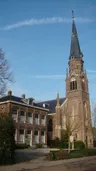
The Roman Catholic church on the Dorpsstraat, in use since 1867, gets its tower after all. The parish priest, J.J. Bruijstens, paid for it out of his own pocket.
The tower was designed by Everardus Margry of Rotterdam, who also designed the church at Hoogmade and the St Bonifatius church in Alphen aan den Rijn. Its height including the cross is 48 metres; the spire alone is 22 metres.
In the porch stand two monumental memorial stones: one of 1559, from the first Nicolaaskerk in the Kerkstraat, and one of 1740, from the old presbytery at Zevenhoven.

The tower and its entrance. The priest paid for it out of his own pocket, according to the entry beside this. View larger →
church tower From the typed document
1887

In 1887

Founding of the Vereniging Johannes Stichting by Dr J. Sasse.
The story begins earlier: the evangelist Smit took in children from the big cities at the Polderhuis, which stood at the crossroads in the village. Out of this came both the Marthastichting and the Johannes Stichting.
The aim was to run an institution for old and infirm people who could not keep themselves and were not cared for by their families – in its own words: "cast-out, uncared-for, dependent, old, weak or infirm persons, whether married or unmarried". Men and women lived separately at first.

care Johannesstichting Researched later
1888

In 1888

The foundation stone for the Johannes Stichting is laid on the street then still known in common speech as the Dorpsstraat, now the A.H. Kooistrastraat.

care Johannesstichting building From the typed document
1892

In August 1892

Dr Sasse proposes carrying the organ of his Johannesstichting over to the school every Sunday, to accompany the singing of the gereformeerde congregation.

organ gereformeerd Researched later
1894

In 1894

The Nieuwkoop steam pumping station is built at Korteraar to a design by W.C. and K. de Wit, fitted with two British Gwynnes centrifugal pumps. It takes over the drainage of the droogmakerij.

water pumping station Researched later
1895

On 22 December 1895

The Gereformeerde Kerk on the Kerkstraat opens.

church gereformeerd From the typed document
1898

In 1898

For the first time a bicycle with pneumatic tyres is sold to someone in Nieuwveen. The buyer was the municipal clerk W. van der Vos; the supplier, the firm Stichter.

transport technology From the typed document