In 1846
Nieuwveen gets its first industry: the wind-powered sawmill De Angenieta, near the Kattenbrug, founded by Jeremias Schoenmakers — son of the Reformed minister Pieter Schoenmakers. The Zaagmolenpad (Sawmill Path) is named after this mill.
Provenance This comes from the series J.J. Roovers set down up to 1970. The wording here is this site’s own. View the source
On this spot
Kattenbrug
- 1823–1825 From 1823 to 1825
- 1823–1825 From 1823 to 1825
- 1860 In 1860
- 1896 In 1896
- c. 1920 Around 1920
- 1925 In 1925
Connected to this
Other events sharing these topics.
In 1896
The sawmill De Angenieta by the Kattenbrug, dating from 1846, is pulled down, timber sheds and all. Pieter Schoenmakers carries the business of the firm J. Schoenmakers on at the Amsterdam Houthaven, where it comes to great prosperity.
 The Zaagmolenpad — “sawmill path”. The sawmill pulled down in the entry beside this is gone; its name is still in the street. View larger →
 In 1799/1800
The corn mill De Fortuijn is put up on what is now the Uiterbuurtweg.
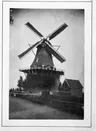 A corn mill in Nieuwveen, from a photograph album. Whether this is “De Fortuijn”, raised in the entry beside it, the source does not say. View larger →
 In the year 1800
Draining of the peat lakes around Nieuwveen begins. Seven windmills set to work pumping the water out into the Amstel.
 “A new drawing towards the drainage of the peat-dug lands”, 1742. The plan to push the water back is nearly sixty years older than the drainage itself. View larger →
 In 1810
The drainage is completed.
The Zevenhoven polder is drained by eight vijzelmolens, Archimedes-screw mills, set up in four "gangs" of two mills each, lifting the water in two stages. The original document speaks of seven mills; the difference probably lies in what exactly was counted as Nieuwveen.
The polder lies deep – the water level is 5.90 metres below NAP, the Dutch ordnance datum – and suffers badly from seepage, which makes daily pumping necessary and keeps it so.
Around 1873
The wind-driven drainage mills disappear one by one; steam pumping stations elsewhere take over their work.
Not all the mills go this early: the lower mill H of the Zevenhoven polder on the Ringdijk, built in 1810, stands until 1926.
 A mill near Nieuwveen, from an album of 1851–1891 — the years in which the water mills were being cleared away. View larger →
 In 1926
The lower mill H of the Zevenhoven polder on the Ringdijk, built in 1810, disappears. What remains of it still stands and is in use as a house.