In 1925
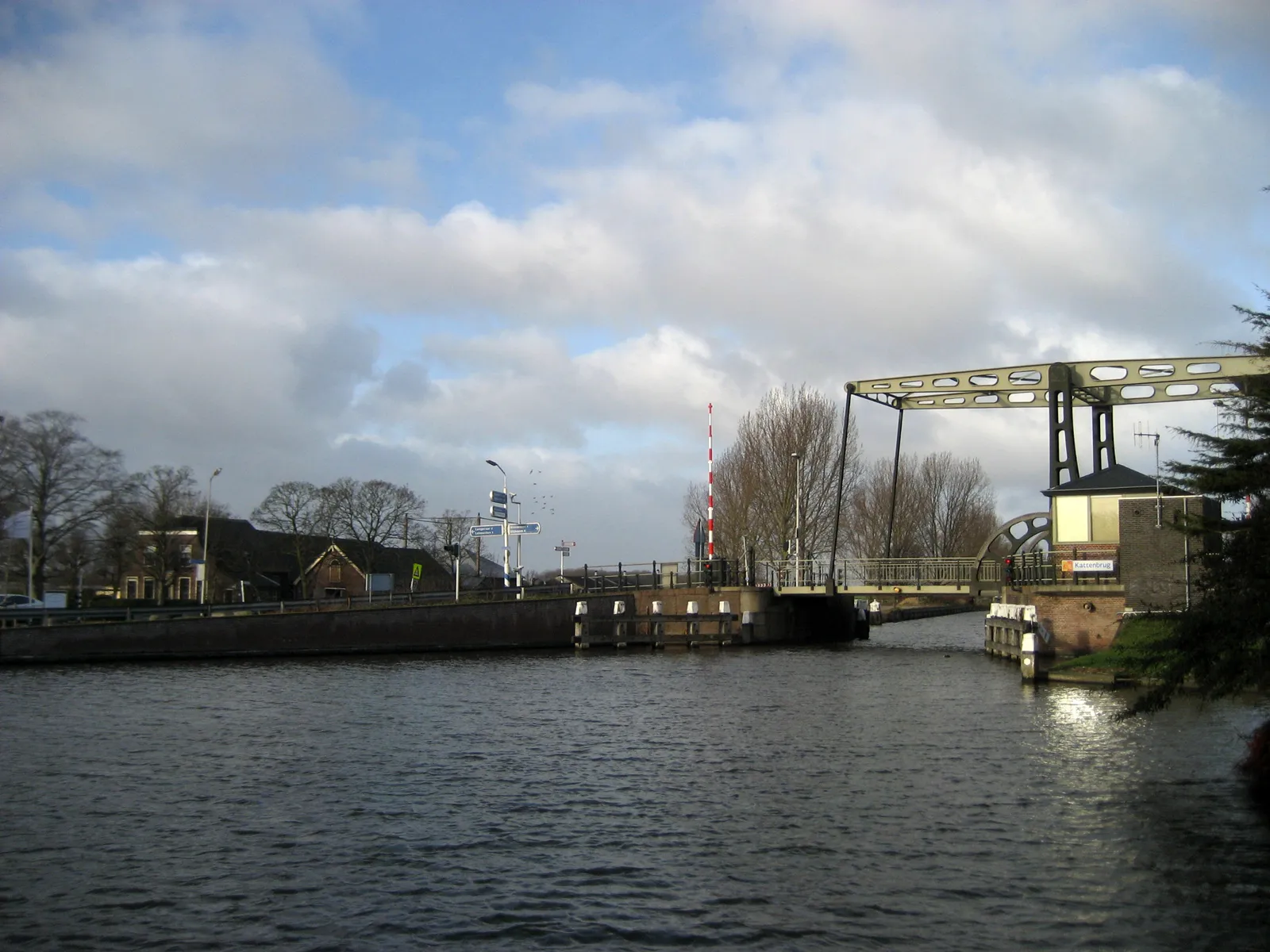
The present Kattenbrug is built.
It replaced the wooden double-leaf drawbridge of 1823–1825. At this point Roovers gives 1824 as the year that wooden bridge was built, and 1823–1825 elsewhere.
Provenance This comes from the series J.J. Roovers set down up to 1970. The wording here is this site’s own. View the source
On this spot
Kattenbrug
- 1823–1825 From 1823 to 1825
- 1823–1825 From 1823 to 1825
- 1846 In 1846
- 1860 In 1860
- 1896 In 1896
- c. 1920 Around 1920
Connected to this
Other events sharing these topics.
In the year 1559
A new Roman Catholic church goes up on the Kerkstraat, replacing the small one already there. The old church was dedicated to St Anne; the new one took St Nicholas as its patron.
From 1823 to 1825
The river Aar is substantially improved and the Aarkanaal dug. The old bridge, the Duivelsbrug (Devil's Bridge), gives way to a wooden double-leaf drawbridge that comes to be called the Kattenbrug.
 The Kattenbrug over the Aarkanaal. The canal is dug in the entry beside this; the bridge still crosses it. View larger →
 From 1823 to 1825
The Duivelssluis, the lock in the Aar beside the Duivelsbrug, falls out of use. A new complex of locks at the Tolhuis in Leimuiden takes its place.
On 14 July 1831
The foundation stone is laid for the new Reformed church on the same site. The architect is Elsmeyer of Nieuwkoop.
Under the State Regulation of 1798 the tower had become the property of the civil municipality, and it is therefore rebuilt at the municipality's commission, to a design by Theo Molkenboer of Leiden. The cost is estimated at 2,100 guilders.
On 22 April 1832
The new Reformed church in the Kerkstraat is taken into use.
 The church taken into use in 1832 in the entry beside this, a little over a hundred and forty years later. View larger →
 In 1888
The foundation stone for the Johannes Stichting is laid on the street then still known in common speech as the Dorpsstraat, now the A.H. Kooistrastraat.