Skip to content
Nieuwveen
Era

From a village with its own municipality to a settlement of Nieuwkoop

1972 – 2026

18 events

1972

In 1972

The new provincial road is completed; the last section is taken into use in 1972, exactly as the original document predicted. The road follows the course of the closed branch railway and relieves through traffic in the built-up area.
The road is later called the N231; part of it bears the name "Oude Spoorbaan", old railway bed, to this day.

roads infrastructure Researched later
1974

In 1974

The Johannes Stichting leaves Nieuwveen. For want of room the residents move to a new complex, De Hooge Burch at Zwammerdam.
With that, after 86 years, the institution that had stood in the middle of the village since the foundation stone was laid in 1888 disappears. The buildings on the A.H. Kooistrastraat are demolished later.
The Jostiband Orkest moves with them; Zwammerdam has been its home base ever since.

care Johannesstichting Jostiband Researched later
1988

On 1 January 1988

Nieuwveen numbers 3,224 inhabitants over an area of 863 hectares.
That is 224 more than the 3,000 of 1969, but the village itself grew by more than that difference suggests: the 1969 figure still counted the roughly 800 patients and nursing staff of the two institutions, and the Johannes Stichting left Nieuwveen in 1974.

population Researched later
1989

On 1 January 1989

In a local government reorganisation the north-eastern part of the Zevenhoven polder, called "Blokland", is added to the municipality of Nieuwveen. This area previously belonged to the municipality of Mijdrecht in the province of Utrecht.
The population rises as a result to 3,597. The municipality now consists of the settlements of Nieuwveen, Blokland and part of Vrouwenakker.

reorganisation government Researched later
1991

On 1 January 1991

The municipality of Zevenhoven is merged with the municipality of Nieuwveen. The new municipality bears the name Nieuwveen for the time being.
That is the end of the independent existence of the neighbouring municipality with which Nieuwveen even shared a mayor until 1927.

reorganisation government Researched later
2003

In 2003

The Protestant primary school in Nieuwveen closes its doors for want of pupils.

education closure Researched later
2007

On 1 January 2007

The municipality of Liemeer merges with Ter Aar and Nieuwkoop to form the new municipality of NIEUWKOOP. Liemeer still numbered 6,962 inhabitants in November 2006.
The town hall of the new, far larger municipality comes to stand on the Teylersplein in Nieuwveen. The village thereby houses the government of a municipality of nearly 30,000 people – a remarkable sequel to the Raadhuis taken into use on the A.H. Kooistrastraat in 1937.

reorganisation government Nieuwkoop Researched later
2011

On 6 February 2011

The Hervormde Gemeente and the Gereformeerde Kerk of Nieuwveen merge into a single Protestant congregation.
Services are henceforth held in the former Reformed church on the Kerkstraat, completed in 1832, which on the merger is given the name "DE ONTMOETINGSKERK", the Meeting Church. The Gereformeerde church building taken into use in 1895 thereby loses its function.

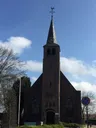
The church in 2022, by then the Ontmoetingskerk — the name that came with the merger in the entry beside this. View larger →
church merger Protestant Researched later
2011

On 1 April 2011

Founding of the Parochiefederatie HH. Clara en Franciscus, into which the parish of St Nicholas, founded in 1865, is absorbed. It later continues as the Heilige Clara Parochie.

church parish Roman Catholic Researched later
2015

On 22 January 2015

The zoning plan for the SCHOTERHOEK II industrial estate is adopted: an extension of about 10 hectares on the south side of the village. The first plots are planned to be issued at the end of 2015.

industrial estate town planning Researched later
2016

In 2016

The Jostiband celebrates its fiftieth anniversary with a concert in a sold-out Ziggo Dome in Amsterdam, in the presence of King Willem-Alexander.

Jostiband music Researched later
c. 2020 approximate

From 2020

Work begins on laying a heat network at Schoterhoek II. The heat source is the effluent – treated wastewater – of the Nieuwveen wastewater treatment plant, combined with aquifer thermal energy storage.
The industrial estate is developed entirely without gas. The businesses become joint owners of the network through a cooperative. On 17 September 2021 the name and logo of the heat network are unveiled.
Exactly fifty years after being connected to the mains gas network in 1970, Nieuwveen thereby takes its first step away from it again.

sustainability heat network energy Researched later
c. 2020 approximate

From 2020

Ipse de Bruggen draws up an investment plan for the period 2020–2032 for making the property on Landgoed Ursula more sustainable and renewing it.
On the 40-hectare estate – grown out of the gentleman's house the Revd Pieter Schoenmakers built on the Dorpsstraat in 1848, by way of "Sassenoord" and "Huize Sint Ursula" of 1935 – some 450 to 500 people with an intellectual disability live. Among other things eighty new care studios are being built, spread over two buildings.

care building sustainability Researched later
2025

On 6 June 2025

Three Stolpersteine are unveiled on the Weteringplein for the Jewish residents of the former Johannesstichting who were deported and murdered in 1943.

war persecution of the Jews remembrance Researched later
2026

In 2026

The town of Nieuwveen numbers 4,559 inhabitants, against 3,742 in 2013 – a growth of 22 per cent in thirteen years. There are 1,641 dwellings, about three quarters of them owner-occupied.
The historic core of the village is a protected conservation area.

population Researched later
2026

In 2026

The diocese of Rotterdam agrees to the disposal of three of the six church buildings of the Heilige Clara Parochie. The H. Nicolaaskerk on the Dorpsstraat – taken into use on 19 August 1867, with the 1886 tower paid for out of his own pocket by parish priest J.J. Bruijstens – closes in 2028.
The parish council is aiming to keep the listed buildings in use with a new public function.

church Roman Catholic Researched later
2026

In 2026

The Jostiband is sixty years old and is appointed Ambassador of Freedom by the Nationaal Comité 4 en 5 mei, the national committee for the days of remembrance and liberation.

Jostiband music Researched later