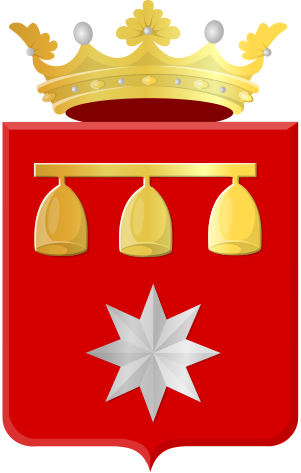
Place
Nieuwveen (village centre)
The historic core is a protected conservation area.
Nieuwveen
What happened here
51 events
Around the eleventh century
The first inhabitants settle in the area around Nieuwveen. They begin draining the peat soil and bringing it into cultivation, so that it slowly becomes fit for arable farming and cattle.
Around the year 1200
A settlement takes shape here that will later be called Nieuwveen.
The name shifted considerably over the centuries: first Nuenvene, then Nijeveen and Niuweveen, in the seventeenth century Nieuveen, after that Nieuweveen, and from 1795 Nieuwveen.
Around the year 1300
The ground holds a layer of fen peat, laagveen. Digging it away gets under way.
In 1628
The oldest house still standing in Nieuwveen dates from this year, according to the Kadaster, the Dutch land registry.
In the second half of the 1700s
The water of the peat lakes swallows the neighbouring village of Schoot and the Uiterbuurt. Nieuwveen escapes by a hair.
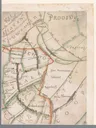 Rijnland in 1615, with Nieuwveen and Nieuwkoop. The map is nearly a century older than the entry beside it, and shows the area before the water had taken so much of the land. View larger →
 In the year 1724
Nieuwveen is no longer governed directly. The Counts of Holland did so first, then — until 1724 — the States of Holland.
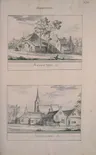 Nieuwveen in the Atlas Schoemaker, eighteenth century — the village as a draughtsman saw it, in the century it was sold as a manor. View larger →
 In the year 1724
For f 15,500,– the heerlijkheid of Nieuwveen — a manorial lordship, carrying rights of jurisdiction and appointment — passes from the States of Holland to the City of Haarlem.
In 1745
Gerrit Willem van der Laan, lord of the manor, transfers the neighbouring ambachtsheerlijkheid of De Uiterbuurt to the City of Haarlem. From this comes the name Nieuwveen met den Uiterbuurt.
 The polders under Kalslagen, Nieuwveen and de Uiterbuurt. De Uiterbuurt, sold as a manor in the entry beside this, is named on the map. View larger →
 From around 1750 to 1800
The peat lakes keep growing and there is less and less to be earned in the village. Nieuwveen falls into crisis and many peat workers are left without work. By the end of the eighteenth century barely more than 500 people live there.
 “A new drawing towards the drainage of the peat-dug lands”, 1742. The plan to push the water back is nearly sixty years older than the drainage itself. View larger →
 In the year 1800
Draining of the peat lakes around Nieuwveen begins. Seven windmills set to work pumping the water out into the Amstel.
“A new drawing towards the drainage of the peat-dug lands”, 1742. The plan to push the water back is nearly sixty years older than the drainage itself. View larger → In 1809
The Nieuwkoop and Zevenhoven droogmakerij – the drained lake-bed polder – becomes a fact. The drainage was a state undertaking.
In 1810
The drainage is completed.
The Zevenhoven polder is drained by eight vijzelmolens, Archimedes-screw mills, set up in four "gangs" of two mills each, lifting the water in two stages. The original document speaks of seven mills; the difference probably lies in what exactly was counted as Nieuwveen.
The polder lies deep – the water level is 5.90 metres below NAP, the Dutch ordnance datum – and suffers badly from seepage, which makes daily pumping necessary and keeps it so.
Between 1810 and 1812
The land won by the draining is parcelled out. For the village it is a fresh start.
Between 1812 and 1850
The first farms go up in the drained polders. With the work the village grows too: more inhabitants, more houses.
In 1846
Nieuwveen too has a cholera epidemic to endure. Eighty people die of it, a tenth of the population.
In 1867
The village gets its first public street lighting: paraffin lanterns. A stubborn fight in the gemeenteraad, the municipal council, came first, and among the population too those for and against were sharply opposed.
On 4 May 1870
Opposite the present Raadhuis (town hall) on the A.H. Kooistrastraat, the foundation stone goes down for the small church of the Evangelisation Society.
Around 1873
The wind-driven drainage mills disappear one by one; steam pumping stations elsewhere take over their work.
Not all the mills go this early: the lower mill H of the Zevenhoven polder on the Ringdijk, built in 1810, stands until 1926.
 A mill near Nieuwveen, from an album of 1851–1891 — the years in which the water mills were being cleared away. View larger →
 In 1894
The Nieuwkoop steam pumping station is built at Korteraar to a design by W.C. and K. de Wit, fitted with two British Gwynnes centrifugal pumps. It takes over the drainage of the droogmakerij.
In 1898
For the first time a bicycle with pneumatic tyres is sold to someone in Nieuwveen. The buyer was the municipal clerk W. van der Vos; the supplier, the firm Stichter.
Early 1900s
Less and less butter and cheese is made on the farms themselves. Mixed holdings appear, with arable farming alongside cattle.
Around 1910
The farmers of Nieuwveen begin using artificial fertiliser.
Around 1914
Motorcycles, cars and lorries make their appearance in Nieuwveen too.
In 1921
The pumping station at Korteraar is converted from steam.
In the year 1922
Electricity reaches Nieuwveen for the first time. Candles and paraffin lamps disappear; electric motors make their entrance.
In 1922
The paraffin lanterns of 1867 give way to electric street lighting.
In 1923
A single fire pump with a petrol engine replaces the two hand pumps. It shifts 900 litres of water a minute.
On 3 September 1923
A daily bus service to Alphen aan den Rijn and Leiden begins, set up by P. Langhout of Ter Aar.
On 16 May 1924
G. Koppenol of Nieuwveen starts the first daily bus service to Amsterdam. On Fridays a service runs to Leiden, for those visiting the cattle market there.
In 1927
The office of mayor, shared from of old with Zevenhoven, is split. Nieuwveen gets J.W. Geesink; Zevenhoven, W.J. Boxce.
In 1927
The first typewriter appears at the municipal office, an Underwood.
 The former municipal secretariat, which was also the post office. This is where the village’s first typewriter stood, according to the entry beside this. View larger →
 In 1932
Drinking water now comes from the mains, supplied by De Elf Gemeenten at Woerden. Rainwater and ditch water fall out of use.
In 1936
The office of mayor of Nieuwveen is merged with that of Rijnsaterwoude and Leimuiden. Mayor J.A. Bakhuizen, successor to J.W. Geesink, lives at Leimuiden and stays there. The arrangement did not go down well in Nieuwveen.
Between 1940 and 1945
Unlike in the First World War of 1914–1918, Nieuwveen too has a hard time of it. In the winter of 1944–1945 food was very scarce: money got you little, bartering got you further.
Roovers closes with the remark that Nieuwveen was spared any fighting. In military terms that is correct, but the village did indeed lose inhabitants to the occupation.
During the war years
Henk Kooistra is killed as well. Kooistra and Speelman were friends from Nieuwveen who both studied in Amsterdam, became involved in the resistance there early on, and were active in the clandestine distribution of pamphlets and of the newspapers "Vrij Nederland" and "Trouw".
Streets in the village were named after both of them after the war; Nieuwveen has a war memorial bearing their names.
 The memorial on the Teylersplein. The cross carries the names A.H. Kooistra and W.P. Speelman, and the words “Van tyrannie bevrijd” — freed from tyranny — with the dates 10 May 1940 to 5 May 1945. View larger →
 In 1942
The municipality adopts its very first expansion plan.
After the year 1945
Mechanisation on the farms of Nieuwveen carries on. Farm work appeals to workers less and less; many take jobs elsewhere, in the rising industries and in house building.
On 17 February 1945
Willem Pieter Speelman is executed by firing squad at Halfweg, together with nine others, in reprisal for a resistance attack on the Amsterdam–Haarlem railway line. He was 26.
Speelman (Sellingen, 20 January 1919) was a son of the gereformeerde minister of Nieuwveen and read economics at the Vrije Universiteit. Shortly after the German invasion he began writing pamphlets calling for resistance. He was arrested at the end of 1942 but escaped using a hacksaw blade hidden in the sole of his shoe. Early in 1943 he was a co-founder of the underground newspaper Trouw, and became the linchpin of its distribution network. On 29 January 1945 he was arrested again in a raid on the S.J.P. Bakker printing works in Amsterdam; under interrogation he gave nothing away.
He was reburied at the Eerebegraafplaats Bloemendaal, the Field of Honour, and posthumously received the Resistance Cross 1940–1945. His parents were imprisoned several times during the occupation to make them reveal their son's whereabouts, and lived for a time in Noordwijk to escape the occupier's attention.
The memorial on the Teylersplein. The cross carries the names A.H. Kooistra and W.P. Speelman, and the words “Van tyrannie bevrijd” — freed from tyranny — with the dates 10 May 1940 to 5 May 1945. View larger → In 1952
The gemeenteraad adopts a bye-law giving every street and road in Nieuwveen an official name — for the first time ever.
On that occasion the names of the two men of the resistance who were killed are fixed: the Stationsweg becomes the W.P. Speelmanweg and part of the Oude Nieuwveenseweg becomes the A.H. Kooistrastraat. That explains the street names Roovers uses throughout without explanation.
In 1953
The Rijkstelefoon, the state telephone service, is automated in Nieuwveen under the dialling code 01723.
The first sub-post office had already opened in 1851, at the house of mayor S. van Driel on what is now the A.H. Kooistrastraat, beside the Raadhuis, in a room that served as the municipal office. He was the first kantoorhouder, office-keeper, though the title at the time was still brievengaarder, letter-gatherer.
On 14 November 1969
Nieuwveen reaches 3000 inhabitants. That includes the residents of the Johannes Stichting and Huize St. Ursula: together some 800 people, patients and nursing staff. Both institutions had grown strongly in those years and become known nationally.
In 1970
The small church of the Evangelisation Society, dating from 1870, is demolished. In its place comes the Netherlands Reformed meeting hall 't Anker.
In 1970
The gemeenteraad of Nieuwveen, seven members strong from of old, goes to eleven now that the village numbers 3000 inhabitants.
And then lastly in 1970
Nieuwveen is connected to the national mains gas network. The coal stoves used from of old, and the oil stoves burning domestic heating oil that had come into use alongside them, are cleared out in great numbers; bottled gas (Butagas) for heating goes out of date.
On the Jaagpad along the Amstel, mains gas is not yet available.
Roovers' series stops here. Everything after this comes from other sources.
On 1 January 1988
Nieuwveen numbers 3,224 inhabitants over an area of 863 hectares.
That is 224 more than the 3,000 of 1969, but the village itself grew by more than that difference suggests: the 1969 figure still counted the roughly 800 patients and nursing staff of the two institutions, and the Johannes Stichting left Nieuwveen in 1974.
On 1 January 1989
In a local government reorganisation the north-eastern part of the Zevenhoven polder, called "Blokland", is added to the municipality of Nieuwveen. This area previously belonged to the municipality of Mijdrecht in the province of Utrecht.
The population rises as a result to 3,597. The municipality now consists of the settlements of Nieuwveen, Blokland and part of Vrouwenakker.
On 1 January 1991
The municipality of Zevenhoven is merged with the municipality of Nieuwveen. The new municipality bears the name Nieuwveen for the time being.
That is the end of the independent existence of the neighbouring municipality with which Nieuwveen even shared a mayor until 1927.
On 1 January 1994
The municipality is renamed LIEMEER. After centuries the name Nieuwveen disappears from the map as the name of a municipality; the village of course remains.
The municipality of Liemeer comprises Nieuwveen, Zevenhoven, Noorden and Vrouwenakker.
 The municipal flag of 1968. In 1994 the name Nieuwveen disappeared as a municipality, and the flag went with it. View larger →
 In 2003
The Protestant primary school in Nieuwveen closes its doors for want of pupils.
In 2026
The town of Nieuwveen numbers 4,559 inhabitants, against 3,742 in 2013 – a growth of 22 per cent in thirteen years. There are 1,641 dwellings, about three quarters of them owner-occupied.
The historic core of the village is a protected conservation area.